 Urban
Urban Each month, we host an SEO update covering the latest in search and AI. In this edition, Carolyn Shelby and Alex Moss discussed Google’s latest AI-driven changes, the impact of AI on content creation, and why simply publishing more content is no longer enough, and could even backfire. Read this recap for the highlights or watch the full May 2026 SEO Update by Yoast to dive deeper.
Watch the full recap on YouTube to dive deeper into these topics, hear some examples and hear the answer to audience questions.
Google’s preferred sources are a boost for publishers
Google released a guide to preferred sources in Google Search for web publishers, allowing users to signal their preference for specific news outlets. This is particularly useful for publishers reliant on ad revenue, as it helps drive more impressions from loyal readers.
Why it matters: If your business model depends on ad revenue from search traffic, this feature can help stabilize or even increase impressions.
Actionable takeaway:
- Publishers should implement the preferred sources feature to maximize visibility.
- Non-publishers, such as eCommerce sites, may not need this, but users can still set preferences for trusted sources.
UCP (Universal Checkout Protocol) expands for AI agents
Google is pushing UCP (Universal Checkout Protocol), an open standard allowing AI agents to complete purchases on behalf of users. Shopify has already integrated UCP, enabling seamless transactions directly from search results.
Why it matters: AI-driven purchases are becoming more common, and eCommerce sites need to ensure compatibility with UCP to avoid losing conversions.
Actionable takeaway:
- If you run an eCommerce site, check if your platform supports UCP. Shopify does; WordPress/WooCommerce may need plugins.
- Ensure product feeds are accurate to prevent issues like incorrect pricing in bundles.
Search indexing vs. grounding indexing: What’s the difference?
Bing clarified the distinction between traditional search indexing (for human users) and grounding indexing (for AI agents). Grounding indexing occurs at inference time, meaning AI models scrape and process visible text without interacting with JavaScript or hidden elements.
Why it matters: Content hidden in accordions, tabs, or behind clicks may not be seen by AI agents, even if it’s indexed by search engines.
Actionable takeaway:
- Prioritize visible, structured content for grounding indexing.
- Avoid relying solely on schema markup, as AI agents primarily read on-page text.
Google drops FAQ rich results (again)
Google has stopped supporting FAQ rich results in search, though they may still appear for certain sites, like medical or government pages. This doesn’t mean the FAQ schema is useless; it may still help with AI responses or future search features.
Why it matters: If you relied on FAQ rich snippets for visibility, you’ll need to adjust your strategy.
Actionable takeaway:
- Keep FAQ schema in place, as it may still be used elsewhere.
- Ensure FAQ content is visible on the page, so don’t hide it in accordions or tabs.
The decline of the “Ultimate guide” and commodity content
Rand Fishkin’s research highlights that long-form “ultimate guides” and low-value listicles are losing effectiveness as AI models synthesize answers directly. Google and AI systems favor authoritative, structured, and differentiated content.
Why it matters: Publishing generic, high-volume content is no longer a viable SEO strategy.
Actionable takeaway:
- Break long guides into bite-sized, structured chapters for better AI consumption.
- Focus on unique insights, original research, and expert perspectives to stand out.
Gemini Intelligence expands on Android
Google is integrating Gemini Intelligence into Android, enabling proactive AI features such as booking appointments and making purchases directly from search results. This shift moves users away from traditional websites, impacting traffic and ad revenue.
Why it matters: Publishers and businesses must adapt to AI-driven discovery rather than relying solely on website visits.
Actionable takeaway:
- Optimize for AI-powered interactions by using structured data and clear calls to action.
- Explore alternative monetization options, such as subscriptions, YouTube, or podcasts.
Google’s AI optimization guide: What you need to know
Google released a guide on optimizing for generative AI features, advising against:
- Creating markdown versions of pages.
- Building AI reference pages, such as
llms.txt, oragents.md. - Publishing duplicate or low-value content for AI consumption.
Why it matters: Google wants to reduce spam and inefficiency in AI-driven search, but these guidelines are specific to Google. Other AI models, such as Perplexity and Claude, may still benefit from structured data.
Actionable takeaway:
- Follow Google’s recommendations for Google, but don’t ignore other AI platforms.
- Focus on high-quality, structured content that works for both search engines and AI agents.
Conde Nast CEO: Assume ad revenue from search traffic is gone
Conde Nast (publisher of Vogue, The New Yorker, etc.) is telling stakeholders to assume programmatic ad revenue from search traffic will decline. This reflects a broader shift in how publishers monetize content.
Why it matters: Publishers must diversify revenue streams beyond programmatic ads.
Actionable takeaway:
- Explore subscriptions, memberships, and sponsorships.
- Repurpose content for YouTube, podcasts, and newsletters to offset traffic losses.
Google I/O 2026: AI agents, personalization, and unified commerce
Key takeaways from Google I/O 2026:
- Search is no longer the primary focus. Google is positioning itself as an AI agent manager.
- Gemini Intelligence is expanding across devices (phones, watches, laptops).
- Unified Wallet integrates UCP for seamless AI-driven purchases.
- Agents and Sparks enable AI-powered research and personalization.
Why it matters: Google is shifting from a search engine to an AI-driven ecosystem, impacting how users discover and interact with content.
Actionable takeaway:
- Optimize for AI agents (structured data, clear answers, personalization).
- Prepare for unified commerce (UCP, AI-driven transactions).
Yoast news
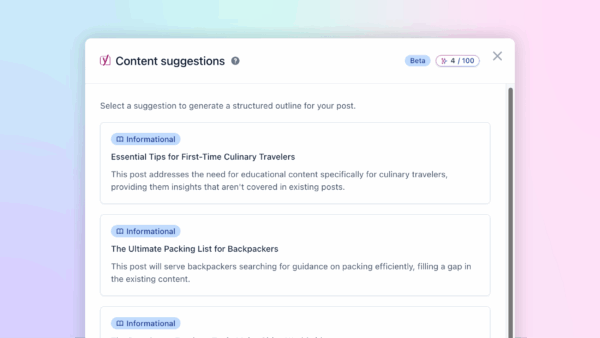
Yoast also shared some exciting news this month with the launch of the Yoast AI Content Planner, a new tool designed to help users overcome writer’s block and create structured, high-quality content effortlessly. The AI Content Planner transforms a blank page into a structured draft in seconds, offering topic suggestions, outline generation, and SEO optimization tips.
It’s a helpful tool for anyone struggling to start or organize their content, saving time and improving readability and SEO. If you’re a Yoast Premium user, you can enable this feature in your WordPress editor and start experimenting with AI-driven content creation.
Sign up for the next SEO Update by Yoast
The next SEO Update by Yoast is on June 30, 2026, at 4:00 PM CET (10:00 AM EST). Sign up here to join live!
The post The May 2026 SEO Update by Yoast recap appeared first on Yoast.